
What’s SPACECOOL?
A breakthrough radiative cooling material enabling zero-energy cooling.
By replicating the natural radiative cooling phenomenon through proprietary optical design, the material features a unique multilayer structure that achieves both high solar reflectance and high thermal emittance—each up to 95%.
This technology contributes to both climate change mitigation and adaptation.

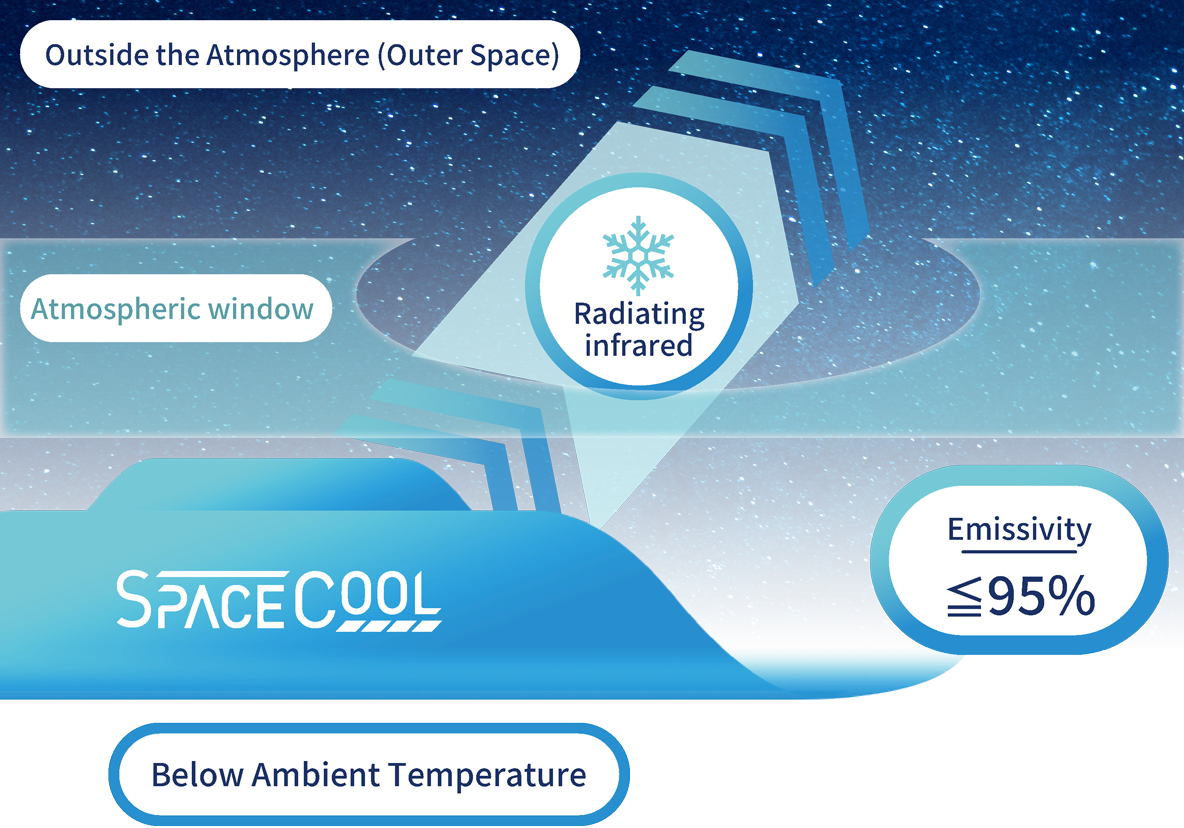
What Is the Atmospheric Window?
Light has wavelengths that vary in their ability to pass through the atmosphere—some have high transmittance, while others are easily absorbed by the atmosphere.
To transport heat into space in the form of light energy, wavelengths with high atmospheric transmittance are ideal. Among these, the 8–13μm wavelength range is particularly transmissive and is referred to as the “atmospheric window.”
Movie
SPACECOOL is a groundbreaking material that delivers world-class radiative cooling performance,
lowering temperatures below the ambient air with zero energy consumption.
It contributes to climate change mitigation and adaptation, supporting the development of a sustainable society.
Solutions
Improving comfort and safety, and contributing to climate adaptation and mitigation.
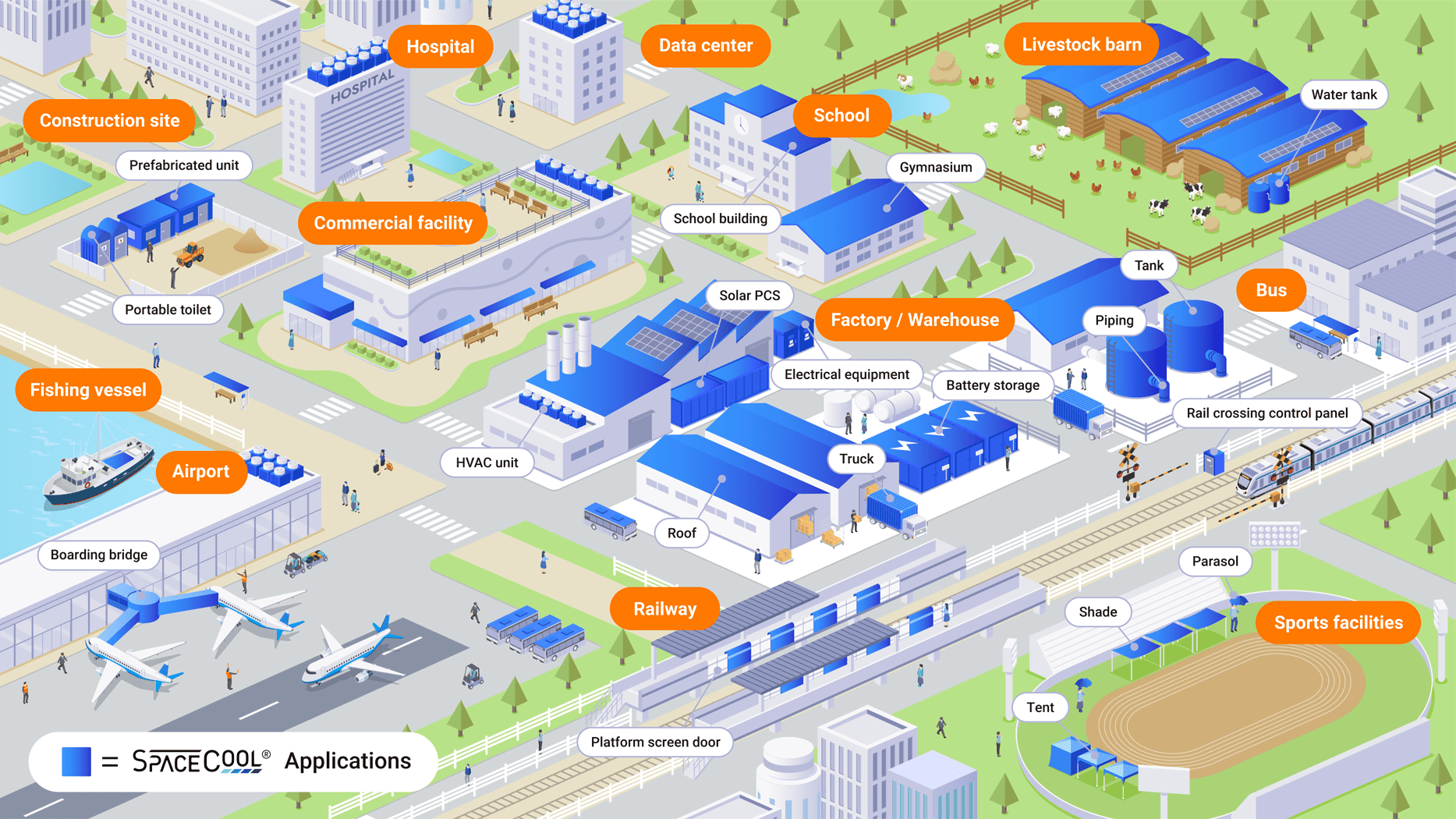
SPACECOOL supports society and people through a wide range of applications.
Comparison
Differences from Conventional Technology
Conventional thermal insulation and heat-shielding materials only reduce the amount of solar heat entering a room; they do not provide any cooling effect. In contrast, SPACECOOL not only suppresses solar heat gain but also actively radiates indoor heat into space, enabling daytime cooling with zero energy—something impossible with traditional technologies.

Line Up
A New Material Redefining Coolness
By replicating the natural radiative cooling phenomenon through proprietary optical design, the material features a unique multilayer structure that achieves.
Demonstration Test
- Summary
- A comparative test measuring the backside temperature of steel plates—one coated with a solar-reflective paint and the other with SPACECOOL.
- Period
- Sep. 01,2017
- Effect
-
A steel plate coated with solar reflective paint remains 10-20℃ above outdoor temperature.
A steel plate with SPACECOOL maintains a temperature below outdoor temperature.

High UV
Resistance
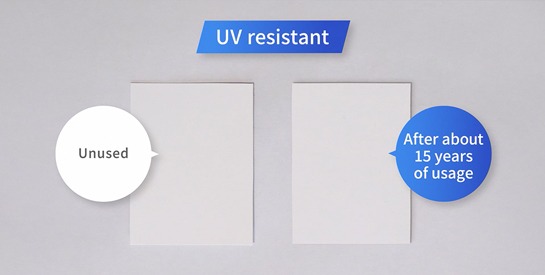
Xenon weathering tests have confirmed that the material has an estimated UV durability equivalent to approximately 15 years.
*Actual durability may vary depending on the usage environment.
*This is not a guaranteed value.
Toward Global Standardization
Establishing SPACECOOL as an International Radiative Cooling Standard
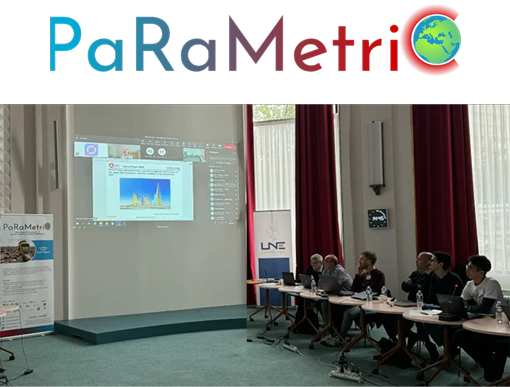
PaRaMetriC is a collaborative research project aimed at establishing international standards for radiative cooling materials.
Scope
Consortium spanning eight European countries
Participants
- 9 National Metrology Institutes
- 2 Universities
- 3 National Research Organizations
- 2 Companies
- 1 Committee
Outcome
Comparative evaluation of radiative cooling materials
based on performance, durability, and scalability.
SPACECOOL was identified as the most advanced material.
SPACECOOL Selected as a Top 100 Start-up in the International "SET Award 2026," Chosen from Over 100 Countries Worldwide — Recognized by the German Energy Agency (dena), a government-affiliated energy organization, as a next-generation energy transition start-up —
The award is operated by the German Energy Agency (dena), a government-affiliated energy organization in Germany, and is supported by the Federal Ministry for Economic Affairs and Climate Action. Within this framework, the SET100 represents a group of 100 start-ups that are internationally recognized as future leaders in driving the global energy transition.
SET Award official website:https://www.startup-energy-transition.com/

Case Studies
01
Average A/C Energy Reduction of 29% in Container Houses Estimated
CO₂ Emissions Reduction of Approximately 21 Tons Over 15 Years
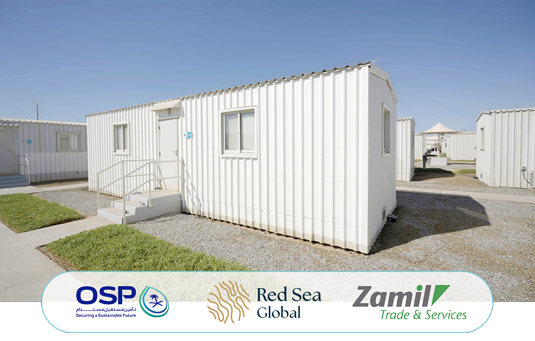

Demonstration Conditions
- Installation Site
- Saudi Arabia
- Installation Area
- Two container houses owned by Red Sea Global (L12 m × W3.6 m × H3.7 m)
Demonstration Results
Occupied container house:
Average A/C energy reduction of 29%, with a maximum reduction of 37%(Measurement period: July 16–24)
Unoccupied container house:
Average A/C energy reduction of 49%, with a maximum reduction of 64%(Measurement period: August 31–September 29)Estimated
CO₂ reduction:
Estimated reduction of about 21 t per container per year (15-year basis)
Calculated independently by OSP and Red Sea Global:
• The application of SPACECOOL extended the air-conditioning system’s lifespan from five to ten years, reducing refrigerant usage by
4.35 kg (equivalent to 9 t-CO₂).
• Reduced electricity consumption for air-conditioning also decreased the required number of solar panels. The manufacturing and
installation of solar panels emit 41 g of CO₂ per kWh. Over 15 years, the energy savings achieved with SPACECOOL amount to 289,080
kWh (equivalent to 12 t-CO₂).
• Total estimated reduction: 21 t-CO₂.
02
Average Electricity Reduction of 7.8% at The 600sqm Office
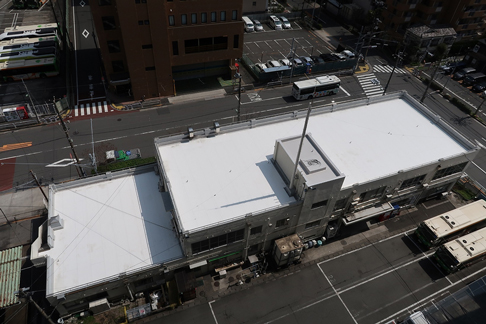
Demonstration Conditions
- Installation Site
- Tokyo, Japan
- Installation Area
- 600 m² Rooftop of an office building
- Measurement Period
- May 1 – September 30, 2024
Demonstration Results
SPACECOOL-integrated waterproof sheets were installed on the concrete rooftop of a Tokyo Metropolitan Bureau
of Transportation facility.
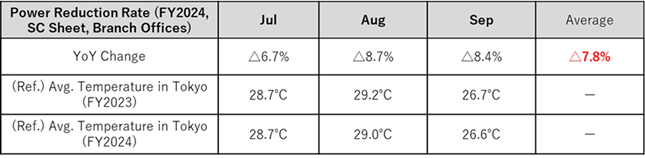
As a result, summer electricity consumption was reduced by a maximum of 8.7%
and an average of 7.8%.
FAQ
Effectiveness & Performance
What is the difference between thermal insulation and heat-shielding materials?
Conventional insulation mainly blocks heat transfer. SPACECOOL’s radiative cooling materials not only reflect and block solar heat but also actively release heat to the sky, helping cool the enclosed space.
How durable is SPACECOOL against weather exposure?
Based on xenon weathering tests, durability is equivalent to approximately 15 years.
Actual lifespan may vary depending on environmental conditions. This is not a warranty.
How does SPACECOOL perform during winter?
SPACECOOL follows the principle of blackbody radiation, meaning the hotter the surface, the stronger the cooling effect. In winter, surface temperatures and sunlight are lower, so radiative cooling is naturally weaker and has minimal impact.
What is the operating temperature range?
SPACECOOL can operate between –20°C to +50°C.
How does it perform on cloudy days?
Clouds reflect infrared radiation back to the surface, reducing cooling compared to sunny days. However, the material temperature remains stable, so overall year-round effectiveness is maintained.
Can SPACECOOL be used indoors?
SPACECOOL is specifically designed for outdoor applications under direct sunlight.
Indoors, SPACECOOL does not provide meaningful heat-shielding benefits, and therefore its use is not recommended.
Can SPACECOOL be folded?
Folding does not affect cooling performance, but it may cause wrinkles or damage.We recommend using it unfolded whenever possible.
Does stacking multiple layers improve performance?
No. Multiple layers do not increase cooling performance.
Where can I find detailed product specifications?
We offer three product types:
• Film
• Magnet sheet
• Tarpaulin
Each has different properties. Please refer to the full technical specification sheets.
Installation
Can I cut the product myself?
Yes. SPACECOOL can be easily cut using scissors or a cutter.
Can I remove and reapply the film?
Yes. Recently applied film can be peeled off and reapplied.
After long-term installation, adhesive residue may remain.
Can I print or paint on the film?
Yes, but covering the surface may reduce cooling performance depending on the printed area.
Can the film adhere to any surface shape?
SPACECOOL adheres well to:
• Flat surfaces
• Cylindrical surfaces
• Gently curved or folded surfaces
It may not adhere perfectly to:
• Spherical shapes
• Rough or textured surfaces
Do I need professional installation?
Anyone can install it.
However, for large areas, high locations, or perfect finishing, professional installation is recommended.
What are the installation steps?
1.Clean the surface
2.Measure the area
3.Cut the film
4.Partially peel release liner
5.Position the film
6.Apply and smooth
What if air bubbles appear?
The embossed adhesive allows air to escape.
Use a squeegee to remove bubbles.
For stubborn bubbles, use a needle and seal afterward.
What if wrinkles occur during installation?
Stop immediately. Peel back to the wrinkle point, remove the wrinkled section, and reapply smoothly.
How can wrinkles be prevented?
Avoid applying uneven force or pulling strongly when removing the liner.
Company Profile
- Company Name
- SPACECOOL Europe GmbH
- Address
- Schellingstr. 109a, 80798 Munich
- Headquarters (Japan)
- https://spacecool.jp/